
On Fire
This morning, Altadena’s Bunny Museum burned while the Getty Villa sealed its library archives to smoke with “state-of-the art air handling systems.”

This week’s wildfires have swept across Los Angeles, burning north of 28,000 acres of land and killing five. The property damage has been as devastating as the images are arresting (Feed Me’s Emily Sundberg writes that nearly everyone at the Knicks game last night could be seen dejectedly flicking through identical images of flames on their phones).
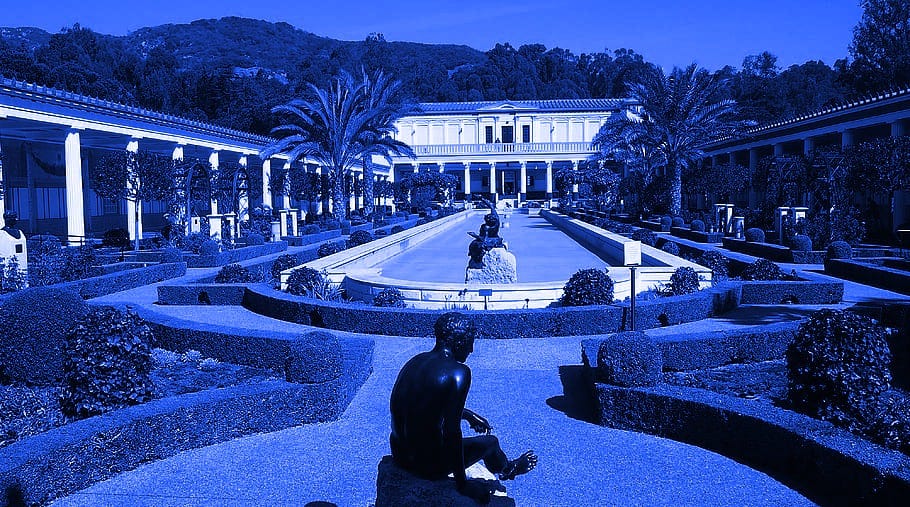
Amidst the general coverage, the Getty Villa museum has emerged as somewhat of a flash point, as media outlets and witnesses watched on to see whether the museum would be caught in the Eaton fire’s path. The Villa, operated by the J. Paul Getty Trust, sits in a recreation of a Roman villa in California’s Pacific Palisades, inspired by the Villa of the Papyri at Herculaneum. It is home to a prominent collection of more than 40,000 art works and artefacts from the ancient world. Despite its location at the heart of the ongoing disaster, the outlook is optimistic. As of latest reports from the museum team, while grounds around the building have been affected, the collection remains safe. The Villa took careful preparatory measures, designing its buildings to the highest fire-proof standards with double-walling and air conditioning. More recently, they aggressively cleared and thinned plant material in the direct vicinity of the site.
Museums are hardly strangers to decisive action to protect their collections in times of crisis. During the Blitz, Churchill's government relocated major works from galleries in London to castles in Wales (or underground into disused tube tunnels, in the case of the Elgin Marbles). The evacuation of the Museo Nacional d’Art de Catalunya’s collections during the Spanish Civil War is detailed in the museum’s new Art & The Spanish Civil War gallery, opened in 2021. The Getty, perhaps surprisingly, does not feature evacuation in its risk mitigation plans for climate events. President and CEO Katherine Fleming elaborates in an interview with NPR: due to the protective measures taken on the grounds and in building design, she argues, “the safest place for the items to be in an event like this, wild as it sounds, is to be at one of our sites.”
“Only 3 in 10 museums have analysed the climate impacts they are likely to be challenged by.”
As the climate crisis develops and natural disasters intensify, risk mitigation and disaster planning will be critical. Museums, galleries, and heritage sites are particularly vulnerable. Their irreplaceable physical artefacts often require careful conditions for conservation, to say nothing of the attendant difficulty of any relocation at scale. And while floods and fires pose clear existential threats to collections, museum works and infrastructure may be no less vulnerable to marginal temperature change, demanding ever more resource-intensive internal climate management systems to maintain proper conditions. Despite this, according to a 2022 Network of European Museum Organisations report, “only 3 in 10 museums have analysed the climate impacts they are likely to be challenged by.”
As in so many other spheres of climate impact, we have good reason to believe the most devastating will not be felt equally across the industry. There is precedent, of course, for striking inequality of this sort: During the Blitz evacuations, every work from the National Gallery was relocated. Other institutions (even, somewhat ironically, the Imperial War Museum) were forced to prioritise which to evacuate and which to leave behind. This morning, Altadena’s Bunny Museum burned while the Getty Villa sealed its library archives to smoke with “state-of-the art air handling systems.”
To be perfectly clear, I believe it is very good that the Getty has the technology and resources to protect its collections. In Fleming’s words, “We [at the Getty] hold on behalf of the world.” But the world must be able to hold its own. In the face of increasingly extreme conditions, we ought to ensure best practices for climate risk mitigation are not exclusive to those institutions prestigious and well-funded enough to apply them.
In 2017, the Louvre opened a new conservation and storage facility in Liévin, purpose-built for a world in climate crisis: The location was selected to protect against risk of “centennial flooding.” Facilities feature “cutting-edge technology to guarantee stable climatic conditions.” This future-proofing did not come cheap, with the French footing a €60M bill. Of this, €19M was paid by the Louvre itself. This outlay was funded with proceeds from the $520M deal licensing use of the Louvre name to Abu Dhabi—owner of 7% of the world’s crude oil reserves.